How to Build Trust on Your Nonprofit Leadership Team
Most leadership teams do not have a trust problem you can see. The meetings happen. The reports get filed. Everyone is competent and collegial. What is missing is harder to spot because it shows up in what never gets said. It is the hard question that never gets asked, the disagreement that stays in someone's head, and the concern raised in the hallway after a meeting rather than in the room during it.
This is the quiet version of a trust problem, and it is the most common dynamic in executive leadership. Nothing blows up. No one quits in a dramatic exit. The team just never gets to the conversations that matter, creating a slow, invisible drag on the entire organization. Trust is built through specific and repeatable behavior, and that work can start whenever a team decides to begin it. For senior leaders, that work usually begins with candor.
What Candor Actually Asks of Senior Leaders
Trust is harder to build at the top than at any other level of the organization. The stakes are higher and the exposure feels greater. The questions you most need to raise with your peers, the ones about your uncertainties or where you might have made a misstep, are exactly the ones that feel too risky to say out loud. So, they go unsaid. Everyone stays professional and guarded, and the team runs on politeness when it needs candor.
Real trust asks for something many senior leaders have learned to avoid. It asks you to be vulnerable in front of the people you most want to look capable in front of. It asks you to say you were wrong, to admit you do not have the answer, to invite a challenge to a decision you have already made. That kind of candor is difficult to practice at the top. It is also what separates a team built on trust from one that merely coexists.
The reason this matters goes beyond the comfort of the room. A leadership team that trusts one another takes responsibility for the whole organization instead of retreating into departmental silos. When trust is thin, people retreat into their silos and defend their turf. When it is strong, they can disagree in the open, share power, and still leave the room aligned. That is the difference between a group of executives and an actual team.
Where Trust Quietly Erodes
Trust rarely collapses in a single event. It erodes through smaller, quieter omissions. One of the most common is leaving people out of the conversations that shape decisions.
A decision gets made in a smaller circle. A few key people learn about it after the fact. Even when the intent was expediency and not exclusion, the message people receive is that they were not essential to the conversation, and that impression is hard to undo.
Greg Petersen, our CEO, once shared a story with our leadership team about exactly this. He had left a couple of key people out of a series of meetings, and he had to go back, unwind what had happened, and rebuild the trust he had compromised. His shortcut ultimately forced him to start the entire process over.
The power of this story rests in his willingness to own the mistake publicly. By naming his own misstep in front of the team, he did two things at once. He reinforced that belonging and collaboration actually mattered to how we work, and he made it safe for everyone else to admit their own mistakes. A leader who can say "I got this wrong" gives everyone permission to be honest about where they got something wrong too. That is trust being built in real time.
Other habits erode trust in much the same way. Defensiveness when challenged teaches people to stop challenging you. When pressures mount, it is easy to default to micromanaging, rushing, or defending your turf. These behaviors can signal that looking like you’re in control matters more than facing reality.
Three Questions to Ask About Your Own Team
- When did I last admit a mistake in front of my leadership team?
- Who on this team disagrees with me, and when did I last hear them do it out loud?
- When I make a misstep that affects a team member, do they bring it to me directly or address it through less productive channels?
Six Rules of Engagement for Leadership Teams
Trust is built through repeated, deliberate behavior, most of it modeled from the top. Here are the practices that matter most.
1. Lead with your own blind spots
You set the ceiling for how candid your team will be. If you never admit uncertainty or a mistake, no one below you will either. Call your own blind spots out loudly, especially when you would rather not. When the most senior person in the room goes first, it gives everyone else permission to do the same.
2. Make mistakes safe to admit
A team that hides errors cannot fix them. When someone owns a misstep, treat it as the behavior you want to encourage. The goal is a culture where admitting you were wrong is normal, because that is the only kind of team that catches problems early.
3. Set shared norms and revisit them
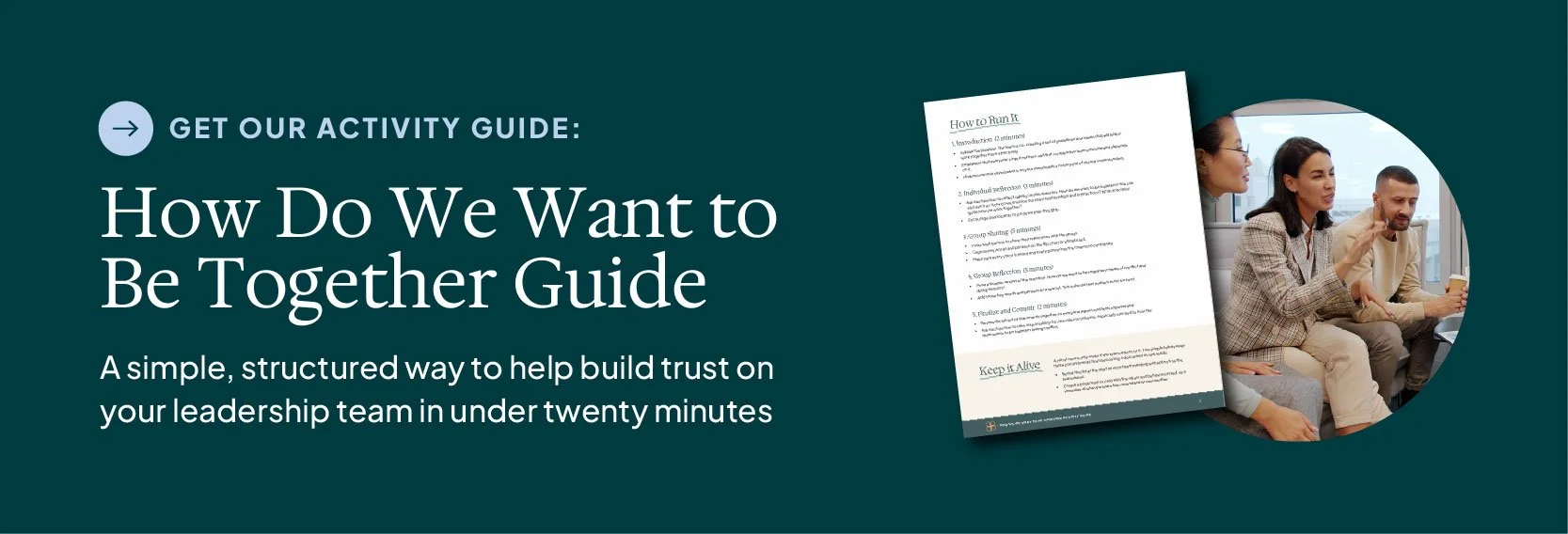
Do not leave how you work together to chance. Agree as a team on how you want to be together, especially when there is conflict, the behaviors you expect from one another, and put it down in writing. Then revisit those norms at the start of your meetings so they stay live rather than becoming a document no one reads. If you want a ready-made way to do this, our one-page activity guide lays out a team exercise you can run in about twenty minutes.
4. Invite the perspectives that challenge you
Actively seek out the views that differ from your own, even the ones that question a direction you have already set. Set aside your ego and look for the truth in what is being said. A team that only hears agreement is not aligned. It is just quiet.
5. Communicate early and often
Silence erodes trust far more than bad news. People fill an information vacuum with their worst assumptions. Tell people what you know when you know it, even when you do not have all the answers. Transparency builds trust, and trust makes difficult realities manageable.
6. Manage conflict instead of avoid it
Conflict on a leadership team is not a sign of dysfunction. When channeled constructively, it is how good decisions get pressure-tested. Stay grounded, listen without becoming defensive, and hold space for discomfort rather than rushing to smooth it over. Teams that can sit in a hard conversation without falling apart are the ones people trust.
A Continuous Practice, Not a Project
Trust is built through continuous practice, in small moments repeated over time. It is the meeting where you admit you were wrong. It is the challenge you invite instead of shut down. It is the norm you actually hold yourselves to.
This is quieter work than most of what fills a leader's day. It is easy to let slide when you are tired and the pressure is on, but those are exactly the moments it matters most.
If your leadership team feels more like a group of talented individuals than a cohesive unit, that is worth paying attention to. It is worth working on. Building collaborative nonprofit leadership starts with trust at the top. It is rarely the work leaders regret investing in.
If you want a thought partner for that journey, it is the exact work we help leadership teams navigate.

Together, we are stronger.
If you need support in leadership development or in balancing your mission and business strategies, we’re here to help.

Mission + Strategy is an invested thought partner to your nonprofit organization. Through our Strategic Advising, Mergers & Partnerships, and Shared Back Office service solutions, we help nonprofits achieve alignment between their mission and business strategies.