Why Nonprofit Succession Planning Is Really Cultural Stewardship
Most succession planning starts with the wrong question. It asks, "Who replaces this person when they leave?" That question matters, but it treats succession as an org-chart problem, one more box to check off in an administrative process. The deeper question is harder and more important. What are we actually trying to preserve when a leader, a manager, or a long-tenured expert moves on?
The answer is rarely just a title. It is the culture they helped build, the relationships they hold, and the institutional knowledge they carry in their heads. Those things do not transfer automatically. When someone leaves, they can walk out the door with years of judgment, context, and hard-won understanding that no job description captures. Succession planning, done well, is the work of keeping those things alive across generations of leadership. It is cultural stewardship.
What You Are Really Handing Off
Think about what gives an organization its identity. It is not the building or the logo. It is the way people make decisions, the values they reach for under pressure, the relationships with funders and partners built over years, and the practical knowledge of how the work actually gets done. That is the real inheritance. When a leader leaves, all of it is suddenly at stake.
Succession is a long-term investment in the people who do the work and the mission we are all here to serve. The goal is to make sure the organization can carry its culture, its knowledge and its mission forward no matter who is in the seat.
We have learned this firsthand. We were founded out of a succession event ourselves, two organizations choosing to join forces to secure long-term mission sustainability rather than face an uncertain future alone. Years later, we spent three years preparing for the planned retirement of a longtime executive rather than waiting for the departure to force our hand. And we eventually moved from treating succession as a single event to managing it as an ongoing program. Each step taught us the same lesson. Succession is not something you do to an organization when a leader leaves. It is something you build into how the organization operates.
The Single Point of Failure
There is a risk hiding inside every strong, seasoned team, and it is worth naming plainly.
We once had a team member who was, by every measure, a rockstar. He understood the state billing process inside and out. He did exacting work, carried years of accumulated knowledge, and was the person everyone relied on to get it right. He was genuinely exceptional at what he did.
Then he passed away, suddenly. It was a real loss, felt first as the loss of a colleague and a person. And in the difficult time that followed, we discovered something else. He had been the only one who truly knew how that work was done. No one else could pick up his work. We had to relearn processes from the ground up, piecing back together knowledge that had never been written down or shared because it had never needed to be. He was that good.
That experience became a touchstone for us. It taught us that a deeply knowledgeable, long-tenured team member is two things at once. They are an enormous asset, and they are a single point of failure. When all the understanding of a critical function sits in one person's head, the organization is exposed in a way it often does not realize until it is too late.
This is the dilemma at the heart of succession. The very people who hold the most institutional knowledge are the people whose absence would hurt the most. The answer is to distribute what they know across the team rather than leave it concentrated in a single role Building the bench, documenting the work and moving knowledge into the shared life of the organization protects both your people and your mission.
Where is Your Knowledge at Risk?
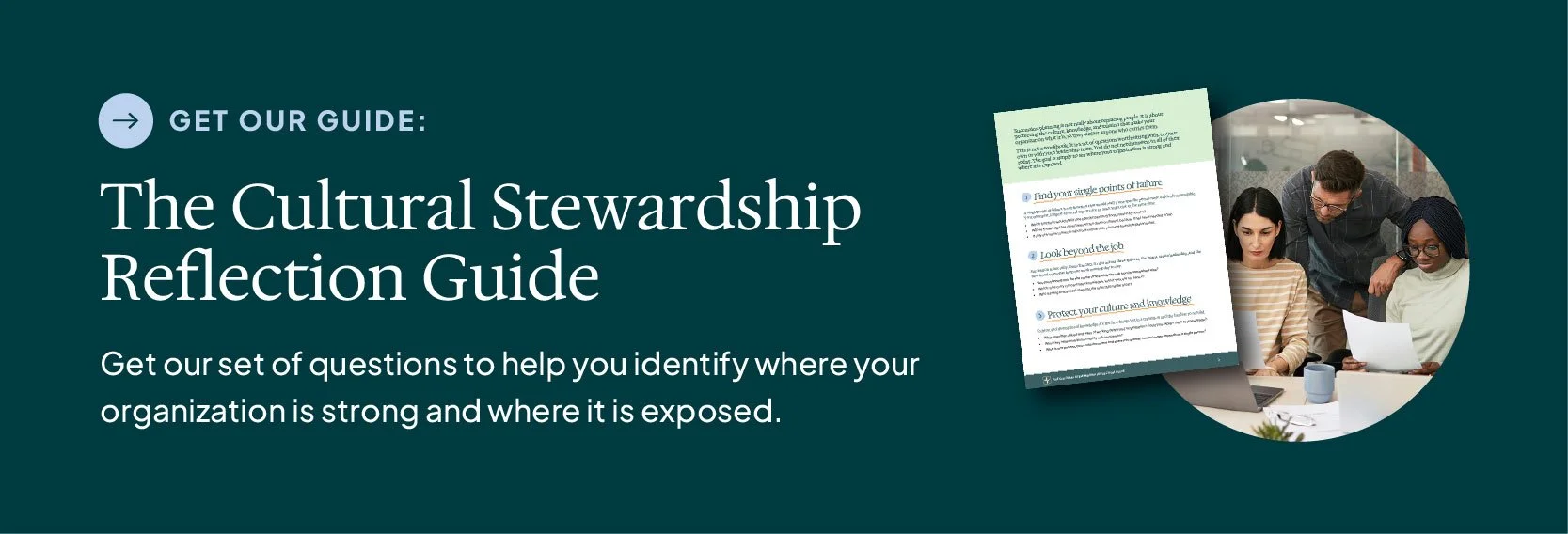
Cultural stewardship starts with knowing where your organization is exposed. Sit with these questions honestly.
- If the most knowledgeable person on your team did not come in tomorrow, what essential work would stall? Name the function, and name the person. If only one name comes to mind, you have found a single point of failure.
- How much of your organization’s critical knowledge lives only in someone's head? Which processes, relationships, or judgment calls have never been written down or shared, because they have never needed to be?
- Who is learning what your veteran team members know? Is anyone being mentored into the roles that matter most, or are you counting on the people already in them never leaving?
- What parts of your culture would be hard to explain to a new leader? The unwritten values and ways of working are often the first things lost in a transition. Could you put them into words?
- Are you talking about succession before you have to? If the honest answer is no, that is the place to start.
You do not have to solve all of this at once. Noticing where you are exposed is the first act of stewardship.
Why These Conversations are Hard
If the case for succession planning is this clear, why do so many organizations put it off? Because the conversations are uncomfortable, and the discomfort is human.
We have experienced this directly. Succession talk surfaces real vulnerability on every side. A leader reporting to a board may worry, will they think less of me if I acknowledge I have a finite amount of time left in this role? Team members may wonder whether the organization's future is secure. Board members may feel uneasy discussing their own eventual departure. And staff may feel threatened when the organization starts talking openly about backing up their roles, as if being backed up means being replaceable.
All of that is normal and deeply human, but it is not a reason to avoid the conversation. We have watched succession-related challenges echo through organizations for up to a decade when they are handled poorly. We have also seen thoughtful, well-planned succession work become the foundation for future growth, sustainability, and impact. The difference is whether an organization is willing to treat vulnerability as a normal part of planning rather than a weakness to hide.
When leaders treat vulnerability as part of planning, the practical work becomes possible. You cannot spread knowledge, develop successors, or plan for the unexpected if no one will say out loud that people leave.
What Stewardship-Minded Succession Looks Like
Treating succession as cultural stewardship changes what you actually do. A few practices make the difference.
Plan for more than the top job. Succession runs across the board, senior leadership and the functional roles that keep the work moving day to day. The colleague who understands your billing process is as worth planning for as the executive who sets strategy. Map all the roles where knowledge is concentrated, not just the corner office.
Treat succession as an ongoing discipline, not an event. Succession planning works best when it is built into the regular rhythm of the organization, reviewed on a schedule, updated as roles and people change, and active long before anyone is leaving. Treating succession as an ongoing program keeps leadership continuity, knowledge transfer and future needs in view. An event mindset produces panic. A program mindset produces readiness.
Build the bench from within. Internal candidates carry something external hires cannot. They already know the culture, hold the relationships, and understand how decisions really get made. Developing them through mentorship, stretch projects, and honest feedback is a form of nonprofit capacity building that prepares successors and sends a clear signal that the organization invests in its people. It is continuity and culture-building at the same time.
Move knowledge out of any single person. This is the direct answer to the single-point-of-failure problem. Document critical processes. Create overlap and cross-training. Make sure that no essential function depends entirely on what one individual remembers. Institutional knowledge that is shared is institutional knowledge that survives.
Prepare for the unexpected, too. Not every transition is planned. A sound approach includes a protocol for sudden or unplanned absence, clear lines of authority, and prepared communication, so that an organization facing an abrupt change still has stability and continuity to fall back on.
The Bottom Line
Succession planning is easy to mistake for paperwork. It looks like charts, candidate lists, and readiness ratings. The paperwork is only the surface. The deeper work is protecting everything that makes an organization what it is, so culture, knowledge and mission outlast anyone who carries them.
The real work of succession is stewarding what your organization has built so the next generation of leaders inherits something whole. The organizations that understand this do not plan for succession because someone is leaving. They plan because the mission is meant to last.
Let's Talk
If something here touched a nerve, a key person who holds too much in their head, a transition on the horizon, or the quiet sense that your organization is not as ready as it should be, it may be worth a conversation.
We offer a free consultation for nonprofit leaders who want to think through their own approach to succession. No pressure, just a chance to talk it through with people who have done this work, and lived it, themselves.

Together, we are stronger.
If you need support in succession planning or in balancing your mission and business strategies, we’re here to help.

Mission + Strategy is an invested thought partner to your nonprofit organization. Through our Strategic Advising, Mergers & Partnerships, and Shared Back Office service solutions, we help nonprofits achieve alignment between their mission and business strategies.