The Unwritten Rules: What Your Organizational Culture is Really Telling You
Most organizations can point to their stated values, whether they appear in a strategic plan, employee handbook or framed statement in the office. Those values matter, but they only tell part of the culture story.
Culture is not what you say you value. It is what people actually do, especially when no one is watching. That real behavior, not the aspiration, is what drives how decisions get made.
You can actively manage culture or ignore it, but you cannot turn it off. For a nonprofit leader, learning to read these invisible dynamics is an essential skill.
Culture is what people do, not what they say
When there is a gap between what people say and what they do, we want to believe their words, because that is easier than facing the contradiction.
But people do not behave according to what they say they value. They behave according to what the culture allows, rewards, or ignores. If you want to understand your culture, you have to look at the patterns, including the ones that make you proud and the ones that make you cringe.
Here is a case that shows how far a well-intentioned practice can drift from its stated purpose:
A nonprofit ran an annual 360-degree performance review. Every staff member was reviewed by six people they chose, covering peers, supervisors, and where appropriate the people they supervised. Feedback was anonymous, on the theory that anonymity would make people honest. There was no conversation about the feedback afterward, just long written narratives.
On paper it looked thorough. In practice the culture bent it into something else. This was an organization that prized harmony and treated conflict as inherently bad, with no concept of healthy conflict, even though it had invested in conflict-resolution training and was proud of that investment. No one addressed the contradiction between the stated value and the actual behavior.
So the anonymous review reinforced exactly what the organization claimed to be working against. People said things under the cover of anonymity that they would never say to a colleague's face. Gossip and back-channel complaints became normal. Staff went to the executive director the way children go to a parent, reporting on each other rather than working things out directly. Trust eroded, because people sensed others were talking behind their backs. They were right.
And the pattern did not stay contained to the reviews. The same fear-based, who-likes-whom dynamic shaped other decisions. Resources got allocated based on who the finance lead personally favored. Clinicians avoided hard clinical topics, including assessing for suicidal ideation, because avoidance was what the culture had taught everyone to do.
None of this was the review's fault. Drop an anonymous review into a culture that prizes harmony and rewards keeping the peace, and it will deepen the silence rather than cut through it. The tool did what the culture told it to do.
What Is Your Culture Telling You?
Reading your culture starts with paying attention to what is already in front of you. Sit with these five questions honestly. They work best answered about your own organization, not in the abstract.
- What is one everyday behavior that clearly reflects a value you claim? Name the value, then name the behavior that proves it is real. If you cannot point to the behavior, the value may still be an aspiration.
- What is one behavior that contradicts what your organization says it values? This is where the signal lives. Where do you notice a gap between what is said and what is done?
- When something important gets decided, who is in the room and who only hears about it later? Patterns in who is included, and who is routinely left out, tell you how power and trust actually work.
- How comfortable are you addressing the behaviors that undermine your culture? Be honest about your own discomfort. The behaviors you avoid naming are the ones the culture is quietly endorsing.
- What is one specific action you could take this month to shape a healthier culture? Reading the signals is the start. Acting on one of them is where change begins.
You do not have to fix everything at once. Noticing what your culture is telling you is the first real step.
Six signals worth reading in your own organization
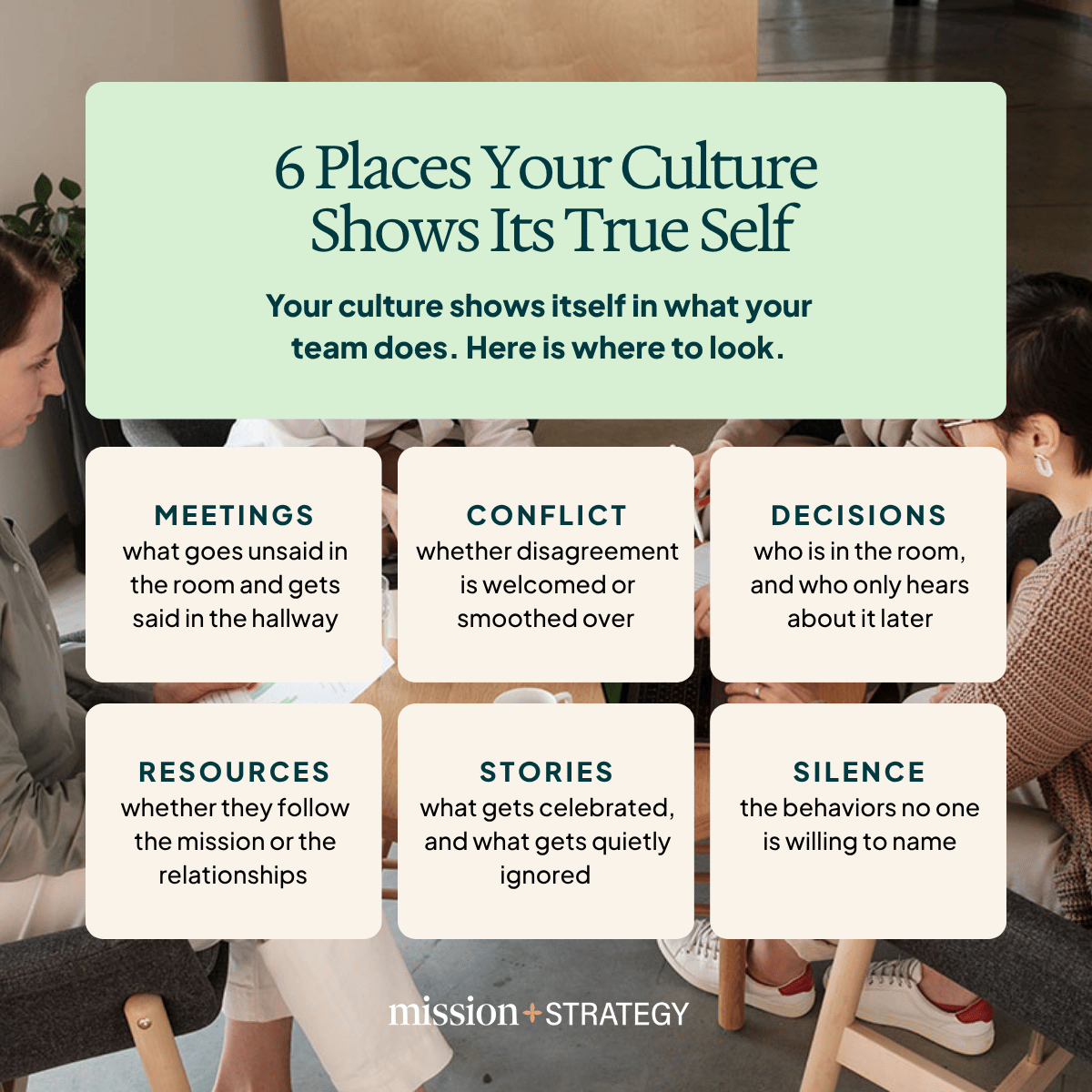
You do not need an assessment instrument to start, though good ones exist. You need to watch what is actually happening and be willing to notice the parts that make you uncomfortable. These six signals tend to reveal the most:
1. Watch what gets avoided in meetings.
Culture shows up in the small mechanics of a room. Who interrupts whom. Whether someone offers a real objection or lets it slide. Whether the quieter people in the room ever get heard, or whether the same few voices carry every conversation. If hard things consistently go unsaid in the meeting and then get said afterward in the hallway, that is your culture telling you it does not feel safe to be direct.
2. Watch how conflict actually goes.
Notice whether disagreement is treated as useful or as a threat to be smoothed over. An organization that prizes comfort will avoid conflict in favor of harmony every time, and will often mistake that avoidance for health. The 360-review story above is the warning here. A team can train extensively on conflict resolution and still never develop the skill of a direct, respectful, difficult conversation, because the culture quietly rewards keeping the peace instead.
3. Watch who decisions route around.
Pay attention to who is actually in the room when something important gets decided, and who only hears about it later. In one organization, a small group of board members made significant calls in isolation, even directing staff and inserting themselves into hiring decisions that belonged to the chief executive, because the culture had made that seem normal. That was both a governance failure and a cultural signal, revealing how decisions were made and who had the power to make them.
4. Watch how resources get allocated.
Follow the money and the support, and see whether they track with mission or with relationships. When people cannot trust each other to speak honestly, decisions drift toward who gets along with whom. In the same organization described above, resources flowed toward the people the finance lead liked rather than toward the greatest need. Allocation patterns are one of the clearest tells you have, because they are hard to dress up.
5. Watch which stories get repeated.
Stories carry and transmit values, personally and organizationally. The accounts people tell at board meetings, in newsletters, and in the hallway reveal what the organization actually celebrates and what it quietly ignores. Listen for the ones that make you proud, and listen just as hard for the ones that make you cringe. If you never hear any cringe-worthy stories at all, treat that as its own signal, and ask why uncomfortable information is being kept from you.
6. Watch what goes unaddressed under stress.
The loudest or most dominant voices shape the norms when no one pushes back. The staff member who yells, the person who is always a little late, the side comments in a meeting, the refusal to back a team decision. The deeper problem is the collective reluctance to confront the behavior. Behaviors that go unchallenged quietly normalize, and the cost can be serious, like a suicide assessment that never gets reviewed because avoidance has become the house style.
Behavior is the real values statement
Culture is the set of unwritten rules that dictate how every decision gets made. While the values on your wall describe the organization you hope to be, the everyday behaviors of your team describe the one you actually have.
When leaders avoid naming misalignments, inaction quietly becomes the norm. That is the real risk. The loudest voices set the tone, the less dominant voices go silent, and the organization starts making choices grounded in fear rather than in what is best for the people and communities it serves.
Hoarded resources and unreviewed assessments are the bill that comes due for behavior no one was willing to confront.
These behavioral signals are already present in your meetings, conflicts, and stories, serving as an early warning system to catch the drift between intention and practice. Your culture is constantly sending signals, and the practical question is whether you are willing to look at them honestly and act on what you see.
What signals is your culture sending?
Taking a clear-eyed look at your own culture is not easy, and you do not have to do it alone. We help nonprofit leaders understand the culture they have and shape it with intention. If anything here resonated, we would be glad to talk it through with you.

Together, we are stronger.
If you need support in organizational culture or in balancing your mission and business strategies, we’re here to help.

Mission + Strategy is an invested thought partner to your nonprofit organization. Through our Strategic Advising, Mergers & Partnerships, and Shared Back Office service solutions, we help nonprofits achieve alignment between their mission and business strategies.