Choosing the Right Model of Nonprofit Collaboration
When most nonprofit leaders think about partnering with another organization, their mind goes straight to full mergers. That instinct makes sense. Mergers are the version of collaboration that makes the most headlines. But a merger is just one option, and reaching for it first is like reaching for the biggest tool in the box before you know what you're building.
At Mission + Strategy, we work with leaders across the full range of partnership options. The goal is to find the structure that actually moves your mission forward, not the most complex one available.
Why Collaboration is a Strategy, Not a Last Resort
Most organizations only start thinking about collaboration when they're already under pressure. The longtime executive director leaves without warning. A major grant disappears. The reserves get tight. By the time the need is that urgent, the options have narrowed and there's little room to negotiate from a position of strength. Nonprofit collaboration works best as a deliberate strategy, something you explore while you still have time to maneuver, a way to expand your reach, build capacity, and serve your community better. Approached that way, it's a growth move, not a last resort.
Collaboration Runs Along a Spectrum
If merging is only one option, the obvious question is what else is on the table. More than most leaders realize. Collaboration runs along a spectrum. At one end are light, flexible arrangements like sharing knowledge, space, or back-office functions. At the other end are deeper, more permanent structures that reshape how organizations operate. At the formal end of the spectrum are the sustained models that involve real structural change. The stakes are higher there, and the choices are easier to get wrong.
The Four Models of Nonprofit Mergers and Partnerships
There are four models worth understanding at the formal end of the spectrum. Each model is defined by how the organizations are structured, who holds control and what happens to each entity once the deal is done. They're arranged below by how much integration each involves, from a narrow exchange between groups that stay separate, to organizations merged as if they were one.
1. Asset Transfer
One organization takes on specific pieces of another. Both stay separate.
In an asset transfer, one organization takes on specific assets from another — programs, property, equipment, sometimes staff, while both remain separate legal entities. Nothing merges. One organization simply hands off a piece of what it does to another organization better positioned to carry it forward.
This is the most common formal partnership structure by far, and for good reason. In our experience, the vast majority of these deals are asset transfers rather than full mergers, because a merger means inheriting the other organization's liabilities along with its assets. An asset transfer lets you take on the program or capability you want without absorbing the debts, legal exposure, or obligations you don't. It's clean, it's contained, and it's often the smartest first move for an organization that wants to grow a specific capacity or rescue a valuable program without betting the whole house on it.
2. Alliance
Organizations stay intact under a new shared parent.
In an alliance, the partnering organizations stay intact and create a new parent entity above them. Each keeps its own identity, programs, and staff, but they now answer to a shared governance structure that coordinates strategy across the group. Think of it as building a roof over two houses that still stand on their own foundations.
An alliance works when organizations want to align and pool their strength without giving up what makes each of them distinct. It's a way to gain the scale and coordination of a larger entity while protecting the local identity and community trust that each organization has spent years earning. The tradeoff is added complexity. You're not simplifying your governance, you're adding a layer to it, and that new parent structure needs its own leadership, its own board, and its own buy-in to work.
3. Joint Venture
Two organizations build and co-own a third.
In a joint venture, two organizations create and jointly own a third. Each contributes assets to the new entity, funding, staff, expertise, programs, and each holds a stake in what they have created. The original organizations carry on as they were. What's new is the venture they now own together.
A joint venture is the right fit when organizations want to pursue something specific together that neither could pull off alone, while keeping the rest of their operations independent. It's narrowly focused by design. A joint venture does not blend two whole organizations. It creates one new thing for a clear purpose, with shared risk and shared reward. The catch is ownership. Two parents sharing one venture means shared control, and that only holds up if both sides are genuinely aligned on what the venture is for and how decisions get made.
4. Merger
Two organizations become one.
A merger is the deepest form of integration. Two organizations become one. A single 501(c)(3) remains, with one CEO and one board, and the other organization ceases to exist as a separate entity. Programs, staff, finances, and governance all combine under one roof. This is the structure many people picture when they hear the word merger, and it is often the most demanding.
Fully integrating two organizations' programs, back-office functions, and funding under one unified structure can end the inefficiency that comes from running parallel operations. But it's also the hardest to pull off. Remember the liability point from earlier. When you merge, you inherit everything, the other organization's debts, obligations, and legal exposure along with its assets. A merger asks two cultures, two staffs, and two boards to become one, and that human work is almost always harder than the legal mechanics. It's the right move when the case for going all the way is clear, but it should be a deliberate choice, not a default.
Questions to Ask Before You Partner
Before you choose a model, take stock of your readiness. Five questions to sit with:
- What specific challenge are we trying to solve, and is a partnership really the best way to solve it?
- Are our mission and culture genuinely aligned with a potential partner's, or do they just look compatible on paper?
- Are our CEO and board aligned on this, and willing to champion the work?
- Have we engaged staff early, especially the people who will carry out the integration?
- Do we have the trust, internally and with a partner, that this kind of work depends on?
Choosing the Right Model
Here's the mistake we see most often. Leaders start by asking which structure they want, when they should start by asking what problem they're trying to solve. Before you weigh any of the four, get specific about the challenge driving you toward a partnership in the first place. Are you trying to add a service your community needs but you can't currently offer? Expand into a new region? Stabilize a program that matters but can't survive on its own? Name that challenge clearly and it becomes your North Star. It points you to the model that actually fits, and it steadies every decision that follows, through the hard conversations, the due diligence, and the long work of making the partnership real.
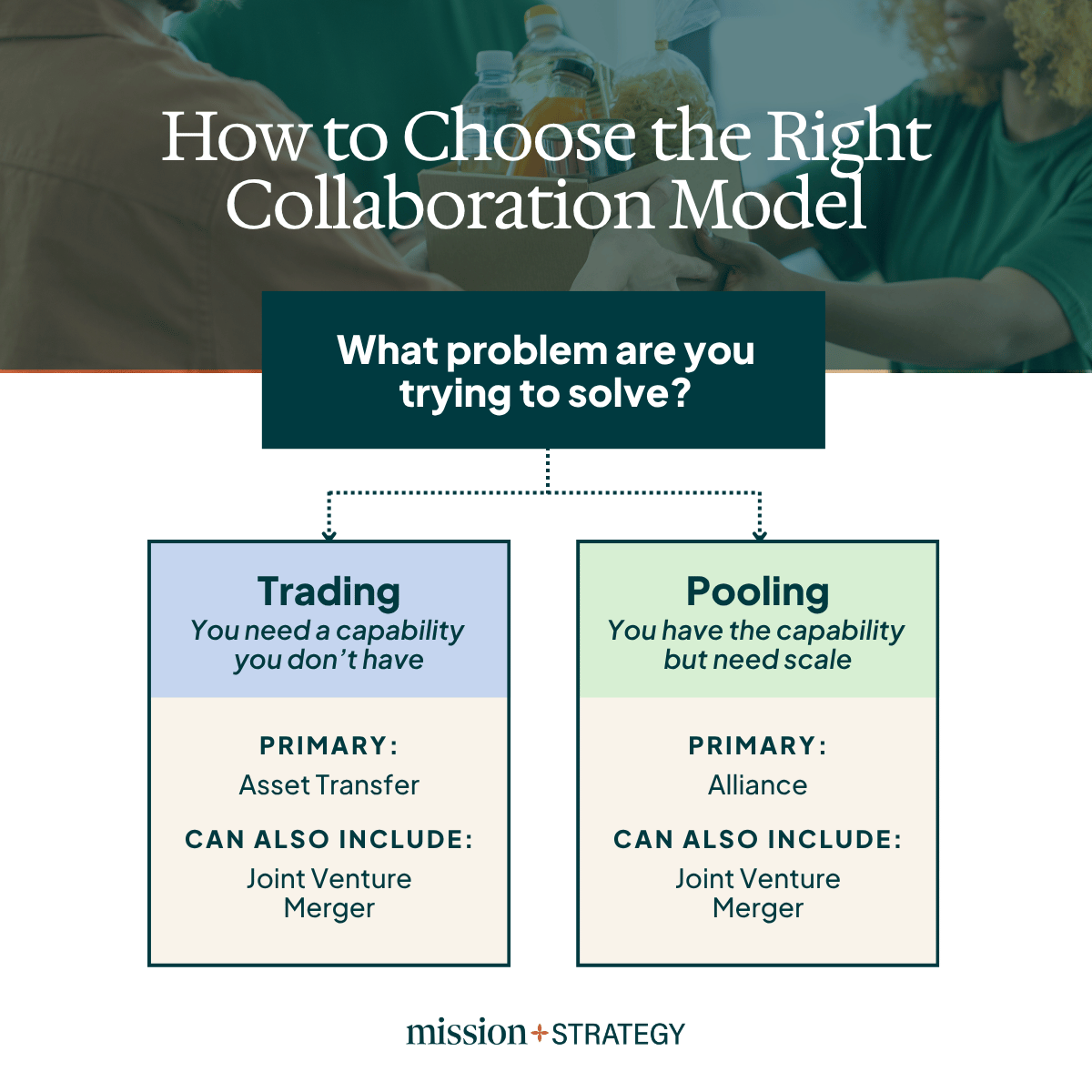
Once you know your challenge, it usually points you in one of two directions. You might be after a capability you don't have. Your mission beneficiaries keep asking for a service, and another organization is already delivering it well. Bringing that capability in is what we call trading. Or you have the capability but not the scale. You do good work and want to reach more people or expand into new territory. Joining forces to extend that reach is what we call pooling. Knowing which one you're after sharpens everything. Trading might point you toward an asset transfer that brings in a specific program. Pooling might point you toward an alliance that extends your footprint while keeping each organization intact. Both paths start from different needs, but they lead to the same underlying goal of greater impact.
Picking the right model is only half the work. The other half is deciding whether your organization is actually ready to partner, and this is where good intentions meet hard reality. The structure can be sound and the strategic case strong, and a partnership can still fall apart over the human factors. A few conditions consistently separate the partnerships that hold from the ones that don't. Trust between the organizations, built honestly over time. Genuine alignment of mission and culture, not just on paper. Clarity about what your organization wants from the partnership. A CEO and board who are aligned and willing to champion the work. And staff who are engaged early, especially in planning and integration. These conditions form the groundwork that determines whether two organizations can actually work as partners, and they take longer to build than any legal agreement.
The Best Time to Prepare for Collaboration Is Now
The leaders who navigate partnerships effectively treat collaboration as part of their strategy long before any single decision is on the table. They have studied the models, named the problem they're trying to solve, and put in the essential work of getting ready. So start now, while the pressure is low and the options are open. Get clear on your challenges. Learn what each model might ask of you, your team, and your board. None of this commits you to anything. It just means that when the right opportunity comes, you'll be ready to move with intention.
This is hard work, and you don't have to sort through it alone. At Mission + Strategy, we help nonprofit leaders think through whether a partnership makes sense, and if it does, which model fits. If you're starting to weigh your options, we'd be glad to be a thinking partner.

Together, we are stronger.
If you need support in mergers and partnerships or in balancing your mission and business strategies, we’re here to help.

Mission + Strategy is an invested thought partner to your nonprofit organization. Through our Strategic Advising, Mergers & Partnerships, and Shared Back Office service solutions, we help nonprofits achieve alignment between their mission and business strategies.