Before You Begin: Assessing Your Readiness for Nonprofit Mergers and Partnerships
If your organization is considering a partnership or a sustained collaboration, start with a simple question. How ready are we, really?
The honest answer, for most, is not as ready as they thought.
This is not a failure. It is the most useful thing an organization can learn before a feasibility study or an MOU is ever on the table. Nonprofit mergers and partnerships are time and capacity intensive, and much of that weight lands on the people at the top. In practice it means a second full-time job added to the one they already carry. It is hard and demanding, but there is a lot a leadership team and board can do ahead of time to smooth the way.
In our sustained collaboration roadmap, this preparation comes before the formal stages begin. It is where the real groundwork gets laid.
A successful partnership can grow your programs, steady your finances, and multiply your impact. For many organizations, it is an option worth exploring.
Why Readiness Matters in Nonprofit Collaboration
Partnership opportunities rarely surface on a convenient schedule. A chance to collaborate with another organization can appear suddenly, and the only question that matters in that moment is whether you are ready to act.
If a viable partner came along tomorrow, how would your board and leadership team react? Would they agree on whether the timing is right, on what you would and would not be willing to give up, on who would even take the lead?
Organizations that can answer those questions likely treat partnership as a standing item for the board and leadership, and they come back to it again and again.
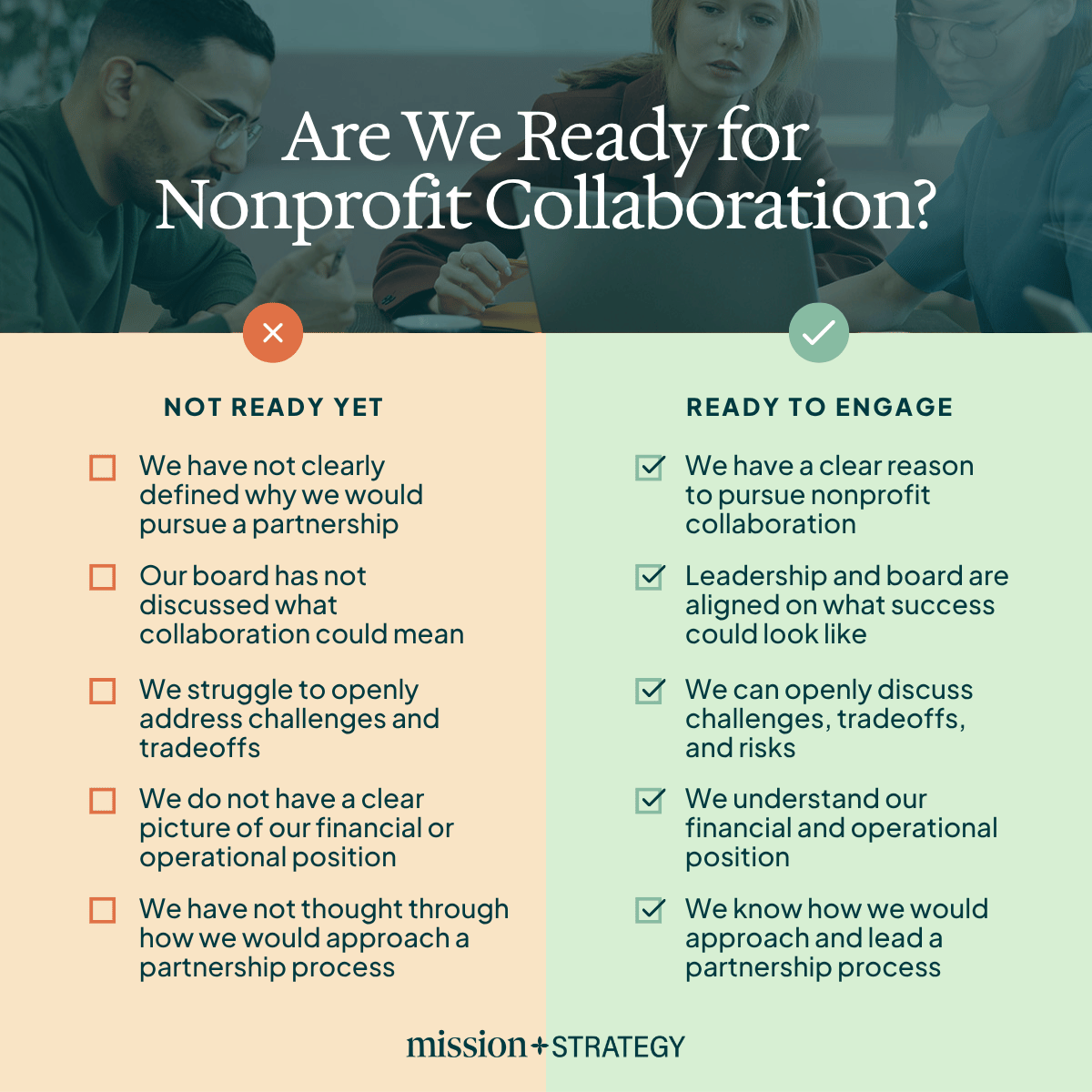
Six Ways to Prepare Your Nonprofit for a Partnership
You will not have every answer. No one does, and you will work out many of the details along the way. What you need is to have started asking the right questions. These are the ones worth returning to as a regular part of how you plan.
1. Know your why.
Start with the goal you are trying to achieve. Could a partner help you get there faster, or more sustainably? Make sure the answer centers the people and communities you serve. What challenge would nonprofit collaboration help you solve, and how would a partnership create more impact than your current path? The strongest partnerships are driven by mission growth, not crisis.
2. Get your board and leadership aligned.
A partnership cannot move forward without agreement at the top. Leadership and the board need a shared sense of why collaboration is on the table and what success would look like, and they have to be willing to take on the complexity that comes with it. Raise the hard questions early, like how much risk you can tolerate and what you are not willing to change. Think too about how a decision would actually get made, who would guide early exploration and what would keep things moving, so you are not figuring that out under pressure later.
3. Build a culture of candor and trust.
Sustained collaboration runs on direct conversation and on trust you have already earned. Can your leadership team openly discuss difficult issues? Do differing perspectives get surfaced and addressed, or do they get smoothed over? Trust works the same way. You do not start building it with a future partner at the negotiating table; you build it well before that, inside your own organization, by doing what you said you would do and owning your mistakes openly. If candor and trust are thin inside your own walls, both are harder across two organizations.
4. Honestly assess your capacity.
Time is the obvious piece, and it is significant, but capacity runs deeper. It is also emotional, the steadiness to lead people through change that can feel frightening, and to hold space for their fear while staying grounded yourself. And it is talent. Do you have the right people to shepherd this, on staff and on the board, and the financial and legal advisors you will need? Take stock of all three before you commit.
5. Know your numbers and operations.
Before any formal process, you should be able to present your current state plainly. That means clear, current financials, a firm grasp of your contracts, obligations, and liabilities, a program model you can describe, and an understanding of your own systems. The point is to see where you stand, find the gaps, and close them over time so you negotiate from a position of strength.
6. Plan how you will communicate.
You will be further along in accepting the change than your staff, so you will almost always under-communicate without realizing it. You may feel like you have said it a dozen times; the twelfth time is often when people first hear it. Decide now how you will keep staff, board, the people you serve, and other stakeholders informed, openly and often, so that when change comes it feels manageable rather than abrupt.
Making Collaboration Part of Your Nonprofit Strategy
Readiness is not a one-time exercise. It works best as a habit, woven into how the organization already operates.
Organizations that prioritize readiness give these questions a regular home. That can start in your strategic plan, where exploring collaboration sits as a named priority alongside your other goals rather than off on its own.
Make time in board and leadership meetings for honest conversation about why a partnership might serve your mission and what it would ask of you. Read and share articles and case studies on sustained collaborations across your leadership team and board, so everyone is learning from the same examples. Some organizations go a step further and form a small committee to keep the topic alive between meetings.
None of this commits you to anything. It keeps the subject in view, builds shared understanding between leadership and the board, and means that when an opportunity does arrive, you are starting from a foundation rather than from scratch.
Ready to start the conversation?
If nonprofit collaboration is on your radar, the first step is not a formal process. It is a candid look at where you stand today.
Connect with our team to talk through where you are and what it would take to move forward.

Together, we are stronger.
If you’re interested in exploring collaboration or in balancing your mission and business strategies, we’re here to help.

Mission + Strategy is an invested thought partner to your nonprofit organization. Through our Strategic Advising, Mergers & Partnerships, and Shared Back Office service solutions, we help nonprofits achieve alignment between their mission and business strategies.