How to Run a Nonprofit Strategic Planning Retreat That Actually Works
Running a strategic planning process in-house can feel daunting. There is a lot to consider, from how to prepare and structure the time to who should participate and how to facilitate conversations so the work is meaningful.
Bringing in a skilled facilitator can help, but if that is not realistic for your organization, you do not need one to run a process that works. With the right structure and a few sound principles, you and your team can do meaningful planning using your own internal expertise. The work becomes more manageable when you have a clear place to begin.
Why Plan in the First Place
Before the how, it helps to be clear about what strategic planning can actually accomplish for your organization. The real value comes from the alignment you build along the way. Through the process, your team and board develop a clearer shared understanding of your mission, vision, values and direction.
The Five Elements of a Strategic Plan
Picture strategic planning as a journey with five distinct waypoints, moving from mission to vision, values, analysis and priorities.
Your mission is the starting point. It is the purpose that tells you why you exist.
Your vision is the destination, the future you are working to create.
Your values are the compass, the principles that guide your behavior and decisions along the way.
Analysis is the map. It is a candid look at your internal strengths and gaps and the external opportunities and obstacles around you, so you can see the path ahead more clearly.
Once the map shows you the way, your priorities are the checkpoints, the handful of things you commit to that keep you moving toward the vision.
One point is worth making up front. You do not have to rewrite your mission, vision or values to make strategic planning worthwhile. Most organizations already have mission, vision and values language in place. The work is to revisit those statements together and align around what they mean now. Even a familiar mission reads differently when a board member and a frontline staff member talk through what it means to them. That shared understanding is what the rest of the work is built on.
Six Fundamentals of Running an Effective Planning Retreat
A good process depends on clear structure and a few principles that keep the work grounded and the participants engaged. Here are six that matter most.
1. Get the right people in the room
A strategic plan built by two or three people at the top will read like it. Your planning is stronger when your board and your leadership team are both at the table, because they see the organization from different angles. Board members bring governance, community perspective, and distance from daily operations. Staff bring the lived experience of how the mission actually plays out day to day. You want both, and you want enough range that the conversation surfaces more than the usual voices. Keep the group large enough to represent real difference and small enough that everyone can be heard.
2. Prepare so the time is well spent
Strategic planning does not have to happen in a single sitting. One focused session can work, or you can spread it across two or three meetings. Whatever fits your organization and your participants is the right choice, and the same principle holds no matter how many sessions you have. Get clear on what each one is meant to accomplish, and build an agenda that moves toward it. Decide what people should read or reflect on ahead of time, whether that is the current plan, recent financials, or a few questions to sit with. Preparation is also where you decide the arc of the day, how you will open, what you will tackle when energy is highest, and where to place a break. None of this has to be elaborate. It just has to be deliberate, so the time you have together goes to the conversation rather than to figuring out what happens next.
3. Offer more than one way to particiapte
This principle does quiet but important work, and leaders often miss it. People engage differently. Some will speak up in a full session without hesitation. Others have just as much to offer but will never volunteer it in front of twenty people, though they will say it readily in a pair or a small group. If your whole retreat runs as one big discussion, you will hear from the same handful of voices all day and miss the rest. So vary how people work. Move between full-group conversation, small groups, pairs, and a few minutes of quiet individual reflection. A mix of ways to participate draws out perspectives that would otherwise stay unspoken.
4. Ground the work in real stories
Strong planning conversations start from experience, not abstraction. Every organization is already telling a story through its habits, its people, and the moments it returns to again and again. Draw those stories out. Build opportunities for dialogue. Ask people to share a specific moment when they saw your mission come to life, or a time the organization was at its best. Stories put everyone on equal footing. A newer board member and a thirty-year staffer can each speak from lived experience, and the themes that emerge become the raw material for everything that follows. They tell you what your organization most wants to protect, strengthen, and carry into the future.
5. Move from insight to a few clear priorities
The point of all the conversation is to set your strategic direction for the next few years Look across the themes and patterns that keep surfacing, and name a small set of priorities that will focus your energy and resources. Three to five is a useful range. The temptation is to keep adding, until the list becomes a catalog of every idea the organization has ever entertained. Resist it. A focused handful of priorities will carry you further than a long laundry list ever could.
6. Make sure people see themselves in the result
A plan that the people in the room helped shape, and can see themselves in, is a plan they will stand behind. As priorities take form, put the participants' own words and contributions to work in them. When a staff member recognizes a theme from the moment they shared, or a board member sees their concern taken seriously, the priorities stop being someone else's agenda and become a shared commitment. That sense of ownership is what carries the work forward after everyone goes home, and it is the real return on bringing the right people together in the first place.
A Free Guide to Get You Started
These six fundamentals will take you a long way. They depend on intention, preparation, the right people in the room and enough space for every voice. You already know your organization better than any outsider could. A good process simply helps that knowledge surface and turn into direction.
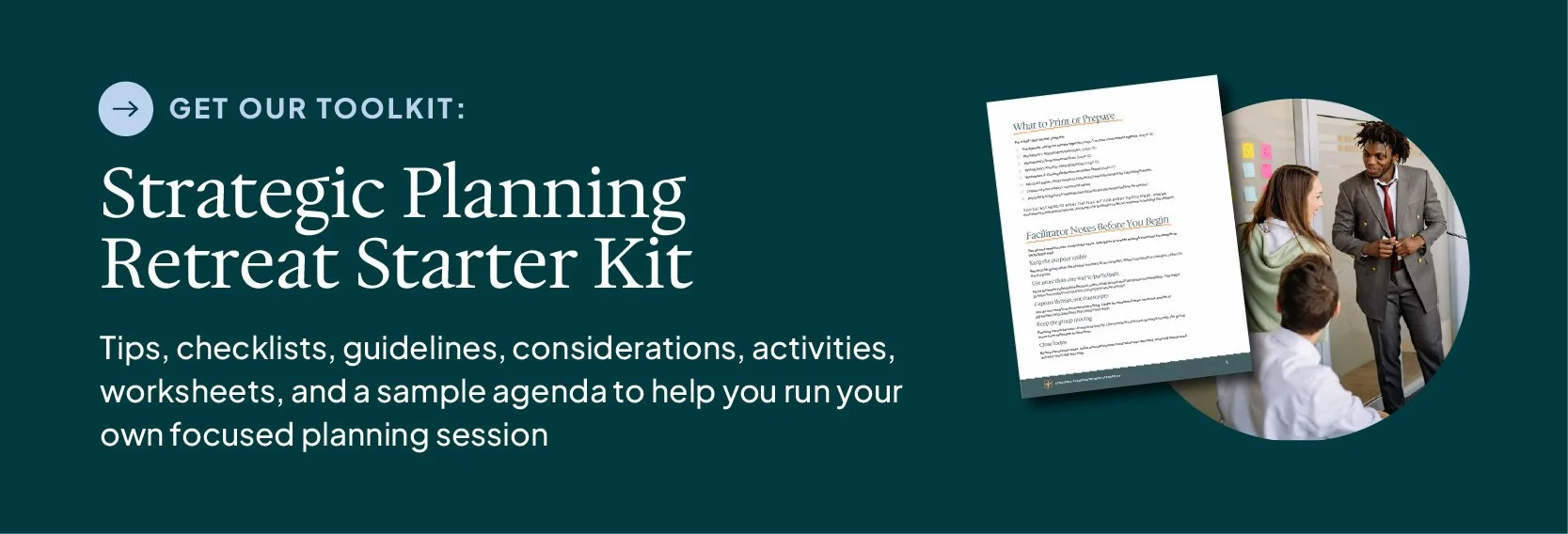
To make this easier, we put together a free companion guide you can download and use with your team. It walks through a few of the things this article describes, including a simple environmental scan you can run yourself, a set of story prompts to spark conversations, and a sample retreat agenda you can adapt to your own needs. Think of it as a toolkit with the essentials you need to begin the work with confidence.
When You Want a Thought Partner
A strategic plan is a living document, and the work of alignment continues long after the retreat ends. If you want to go deeper on why that alignment matters so much, we wrote about it in “Strategic Planning as a Path to Alignment.”
You can do this on your own, and we hope this guide helps you start. There are also moments when an outside facilitator makes a real difference, when the conversations are likely to get hard, when leadership is divided, or when you simply want everyone free to participate without also running the session.
Facilitating nonprofit strategic planning is the kind of work we do. If you reach a point where a thought partner would help, we would be glad to talk it through with you.

Together, we are stronger.
If you need support in strategic planning or in balancing your mission and business strategies, we’re here to help.

Mission + Strategy is an invested thought partner to your nonprofit organization. Through our Strategic Advising, Mergers & Partnerships, and Shared Back Office service solutions, we help nonprofits achieve alignment between their mission and business strategies.