From Insight to Strategic Priorities: How Nonprofits Choose What Matters Most

Strategic planning asks nonprofit leaders to engage in deep reflection. Teams revisit identity; they clarify mission and vision; they explore values and look honestly at the environment around them. These conversations generate insight that is rich and meaningful. Yet every organization eventually arrives at the same question: what do we focus on now?
Choosing strategic priorities for nonprofits is one of the most important moments in the planning process. It is also one of the most challenging. Nonprofits carry many responsibilities. They serve communities with complex needs. They balance immediate demands with long term commitments. They operate in environments shaped by policy, funding and changing expectations. In this context, prioritization can feel like narrowing possibilities or setting aside work that also matters.
But the truth is this. A strategic plan gains its strength from focus. Clear priorities help organizations direct their energy, allocate their resources and create meaningful progress. Without focus, even the most passionate teams struggle to move forward.
Begin with Insights That Reveal Organizational Identity
Strategic priorities grow from understanding who the organization is at its best. In early planning conversations, staff and board members often share meaningful stories about moments when the mission felt alive. These stories reveal patterns that point toward the organization’s identity and strengths. They show what people value and what makes the organization effective.
When leaders look at these stories collectively, themes begin to emerge. These themes do more than describe the past; they illuminate what the organization can build on in the future. Identity becomes a guide for choosing priorities that align with the organization’s core strengths.
Use Values to Filter Your Strategic Choices
Values help organizations determine which choices will feel authentic. During planning, teams often reflect on how the organization behaves in practice and how its culture shapes nonprofit decision making. These conversations reveal the values that are truly lived and the values the organization hopes to strengthen.
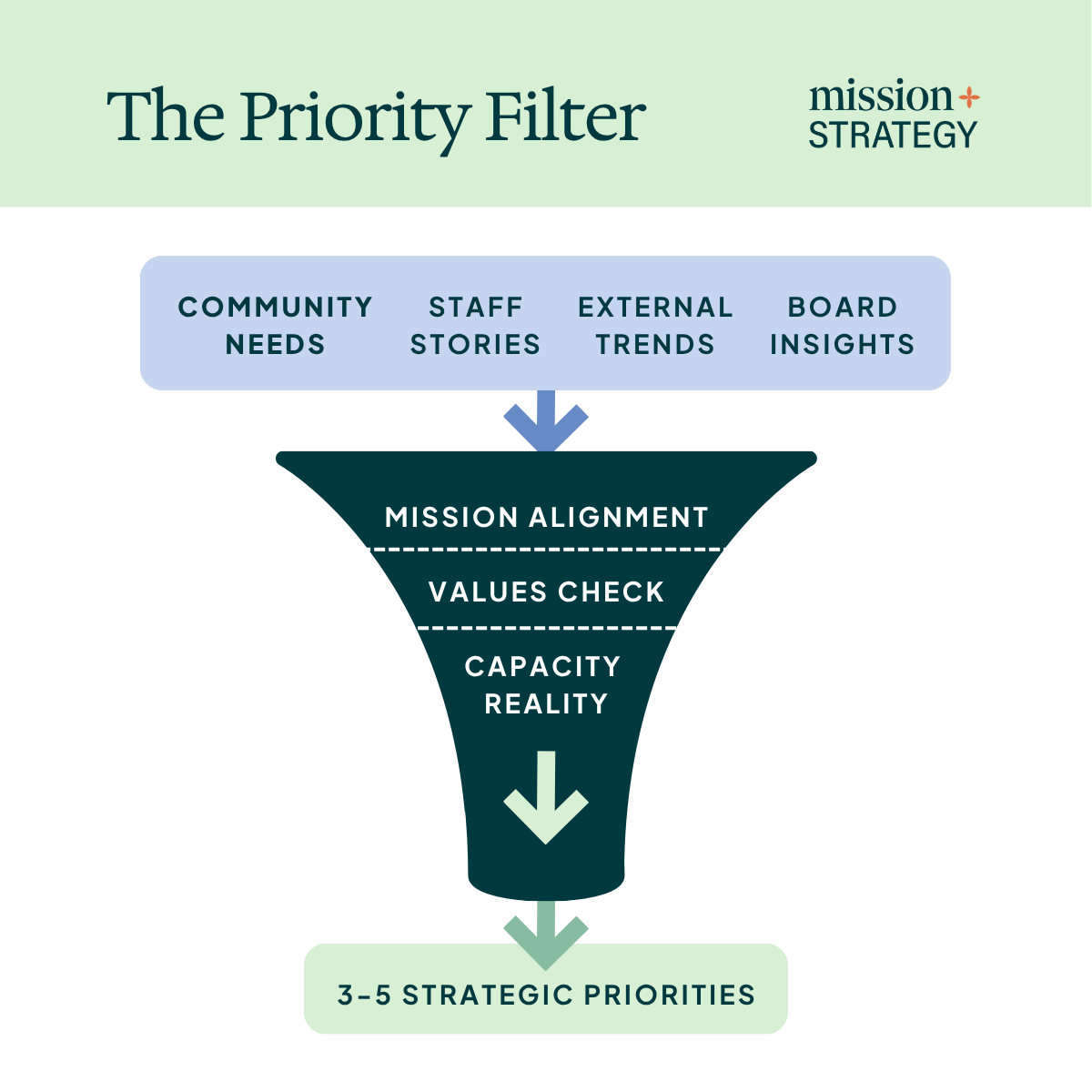
When setting priorities, values can serve as a filter. They help leaders ask: which directions honor the way we want to show up in the world? Which choices align with what matters to us? Which priorities support the culture we want to cultivate? Values provide the clarity needed to choose a direction that feels consistent with the mission.
Ground Decisions in a Shared Environmental Understanding
Strategic priorities must reflect the reality of both internal conditions and the external landscape. By the time organizations enter priority setting conversations, teams have typically discussed strengths, challenges, opportunities and risks. These reflections help create a shared perspective on what is happening inside and around the organization.
This shared understanding is essential for identifying priorities. When board and staff see the environment through a similar lens, they are more likely to agree on where the organization can have the greatest impact. A strong priority reflects a meaningful intersection. It should address something that matters to the community, aligns with the mission, draws from organizational strengths and responds to the current environment.
Look for Patterns That Repeat Across Conversations
Strategic priorities rarely appear all at once. They emerge through repeated themes in conversation. When leaders listen closely, they often notice that certain ideas or challenges keep resurfacing. These patterns can indicate areas where the organization has the greatest potential to move the mission forward.
As themes repeat across groups, the strongest priorities rise naturally. This dynamic can be seen in reflective planning discussions that invite participants to consider what strengths to leverage, which challenges matter most and which opportunities or risks have the influence on future success. The goal is not to capture everything but to identify what consistently matters.
Choose Priorities That Are Directional, Not Restrictive
Strategic priorities are not tactical tasks. They are directional commitments that shape how the organization will move forward over several years. They should be broad enough to allow flexibility but clear enough to provide focus.
A strong strategic priority should be:
Relevant to the mission
Grounded in insight
Inspiring to staff and board
Actionable with available capacity
Flexible enough to grow as conditions change
Balance Ambition with Practicality
Every organization must balance what is possible with what is needed. Ambitious priorities inspire hope while practical priorities recognize capacity and current constraints. The most effective priorities live at the intersection of both.
During planning, teams often benefit from asking what will create the greatest positive change and what will support long term mission resilience. These questions help leaders focus on high value direction without overwhelming the organization with unrealistic commitments.
Invite Shared Ownership Through Collaboration
Priorities gain strength when the people responsible for enacting them feel ownership. Collaborative conversations give staff and board members a shared stake in the future. When people see how their insights contributed to the organization’s direction, they feel more invested in making the strategy real.
Shared ownership creates forward momentum. It strengthens alignment and prepares the organization for implementation.
Ready to find your focus?
If your organization is ready to explore how to identify priorities that support your mission and strengthen your future, we welcome you to schedule a discovery call.

Together, we are stronger.
If you need support with strategic planning or balancing your mission and business strategies, we’re here to help.

Mission + Strategy is an invested thought partner to your nonprofit organization. Through our Strategic Advising, Mergers & Partnerships, and Shared Back Office service solutions, we help nonprofits achieve alignment between their mission and business strategies.