Beyond Mergers: Understanding the Full Spectrum of Nonprofit Collaboration
When thinking about nonprofit collaboration, many executives immediately jump to full mergers. While a merger is a powerful tool, it is just one option within a much broader spectrum of nonprofit mergers and partnerships.
At Mission + Strategy, we help leaders explore the full range of strategic restructuring options. The goal is never to default to the most complex structure. Instead, the goal is to identify the unique model that best advances your mission.
Why Strategic Nonprofit Collaboration Matters
Strategic nonprofit collaboration is not just a defensive reaction to financial pressure. It is a proactive growth strategy. It allows forward-thinking organizations to expand their reach, increase community impact, and secure long-term financial sustainability.
In a sector facing growing community needs and limited funding, working together helps organizations maximize resources. However, not all models yield the same results. Understanding your options is essential for choosing the right path forward.
The Spectrum of Nonprofit Collaboration Models
We divide collaborative frameworks into two primary categories: flexible partnerships and sustained collaborations. Each tier requires a different level of integration, legal complexity, and long-term commitment.
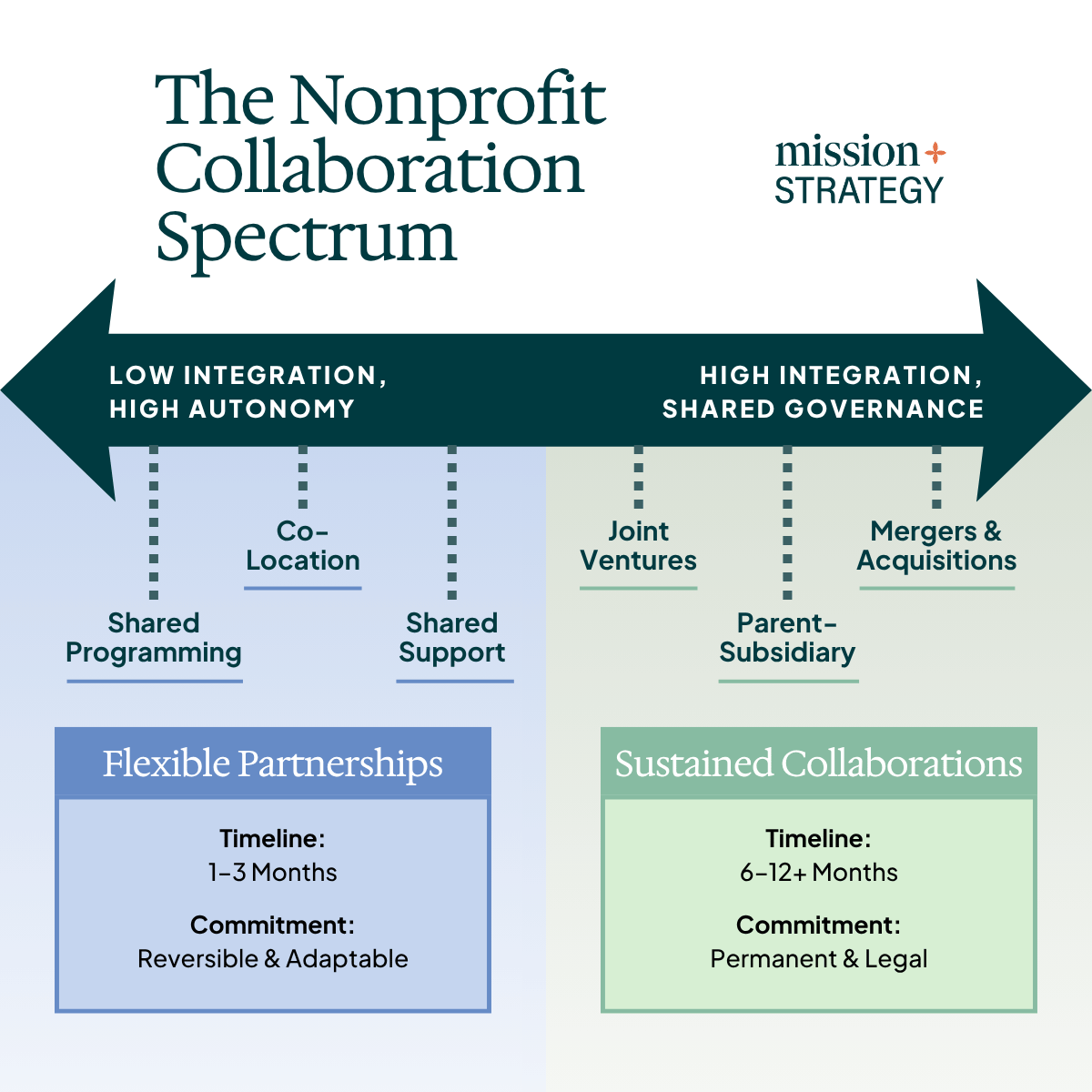
Flexible Partnership Models for Nonprofits
These low-risk approaches are easy to launch and simple to adapt. They allow organizations to test values alignment without committing to permanent, structural changes.
Shared Programming: Organizations co-design and deliver community services.
Best for: Expanding program reach without duplicating local efforts.
Example: Two youth agencies co-develop a single after-school initiative.
Co-location: Partners share physical office space or facility assets to reduce overhead.
Best for: Lowering administrative costs and increasing daily cross-team coordination.
Example: Three human services organizations operate out of a single community hub.
Shared Support Functions: Organizations pool back-office administrative services like HR, IT, marketing, or finance.
Best for: Driving nonprofit back office sharing efficiency so teams can focus entirely on mission delivery.
Example: Multiple local nonprofits hire a single shared accounting and HR provider.
Sustained Collaboration Models for Nonprofits
These models require deep operational integration and represent formal nonprofit mergers and partnerships. They demand legal agreements, shared governance, and tight cultural alignment.
Joint Ventures: Nonprofits create a binding agreement to manage a specific initiative together.
Best for: Tackling a highly focused, time-bound community opportunity or advocacy campaign.
Example: A collaborative regional housing study funded by multiple foundations.
Parent-Subsidiary Structures: One central organization provides governance oversight while maintaining separate legal entities.
Best for: Balancing regional scaling and strategic alignment with local community autonomy.
Example: A national advocacy group expands by acquiring local affiliates as subsidiaries.
Mergers and Acquisitions (M&A): Two or more organizations legally combine operations into a single corporate entity.
Best for: Deep brand alignment, permanent financial sustainability, and long-term mission preservation.
Example: A small niche charity integrates into a larger regional provider to protect its legacy programs.
How to Choose a Nonprofit Collaboration Model
The most effective nonprofit collaboration is one that aligns perfectly with your current culture, finances, and long-term strategic plan. When evaluating options, strategic restructuring for nonprofit leaders should begin with four essential questions:
What specific community problem are we trying to solve?
What level of operational integration can our staff handle today?
Which organizational capabilities must remain fully independent?
What are the cultural hurdles between our potential partner organizations?
A Strategic Choice for Future Impact
Successful nonprofit mergers and partnerships are never shortcuts. They require intentional planning, transparent dialogue, and clear performance metrics.
When approached as a strategy rather than a crisis response, collaborative models unlock innovation and operational efficiency. The future of the social sector depends on how effectively organizations work together to serve their communities.
Frequently Asked Questions About Nonprofit Collaboration
-
Nonprofit collaboration is an umbrella term covering all shared efforts. It ranges from informal program partnerships to formal integration. A merger is simply the most permanent, legally integrated form of collaboration.
-
Executive directors and boards must evaluate mission alignment, staff capacity, financial risk, and the desired level of independence before choosing a structure.
-
No. Many organizations achieve better, faster results through flexible partnership models for nonprofits. These alternatives offer high impact with significantly lower legal risk and overhead.

Together, we are stronger.
If you’re interested in collaboration or balancing your mission and business strategies, we’re here to help.

Mission + Strategy is an invested thought partner to your nonprofit organization. Through our Strategic Advising, Mergers & Partnerships, and Shared Back Office service solutions, we help nonprofits achieve alignment between their mission and business strategies.