The Sustained Collaboration Path: Nonprofit Strategic Partnership Roadmap
Mergers and sustained partnerships can feel daunting. The stakes are high, the process is complex, and the path forward isn’t always clear. However, with the right roadmap, nonprofit collaboration becomes a powerful strategy for mission impact and sustainability rather than just an overwhelming task.
At Mission + Strategy, we guide organizations through a six-step process that brings structure and momentum to the journey. In nonprofit partnerships, we believe the process is the strategy.
1. Preparation: Start with the Why
One of the most powerful readiness exercises is identifying the organizational challenge a partnership could help solve. This becomes your North Star: the strategic rationale that guides every decision along the way. Are you trying to expand your geographic reach, offer services you currently can’t, stabilize your workforce or increase operational efficiency? Naming the challenge helps focus the conversation and keeps the process grounded in mission rather than ego or urgency.
Early on, it is critical to determine which sustained collaboration model fits your goals. You might consider:
Asset Transfers: These are often preferred for their flexibility. By transferring specific programs or assets, organizations can avoid the risk of liability associated with taking on an entire entity’s past legal obligations.
Statutory Mergers: A "true" merger where two entities become one and the survivor assumes all assets and liabilities by operation of law.
Alliances, Joint Ventures and Parent-Subsidiary Models: These allow for shared operations while maintaining separate legal identities.
To lead this effort, it is often a good idea to form a Partnership Committee. This group usually includes the CEO and a selection of Board members who can explore these models and profile an ideal partner.
2. Exploration: Assess Feasibility
Once you identify a potential partner, the work shifts to mutual discovery. A Joint Planning Committee helps both organizations navigate a partnership feasibility assessment. These assessments serve as a pivotal decision point by providing an objective analysis of compatibility, goals and strategic fit.
While these assessments are a valuable roadmap for decision making, they complement rather than replace the due diligence required later. This phase culminates in the first Go/No-Go Decision: the Board vote on a Letter of Intent (LOI). While non-legally binding, this signals a shared interest in moving forward.
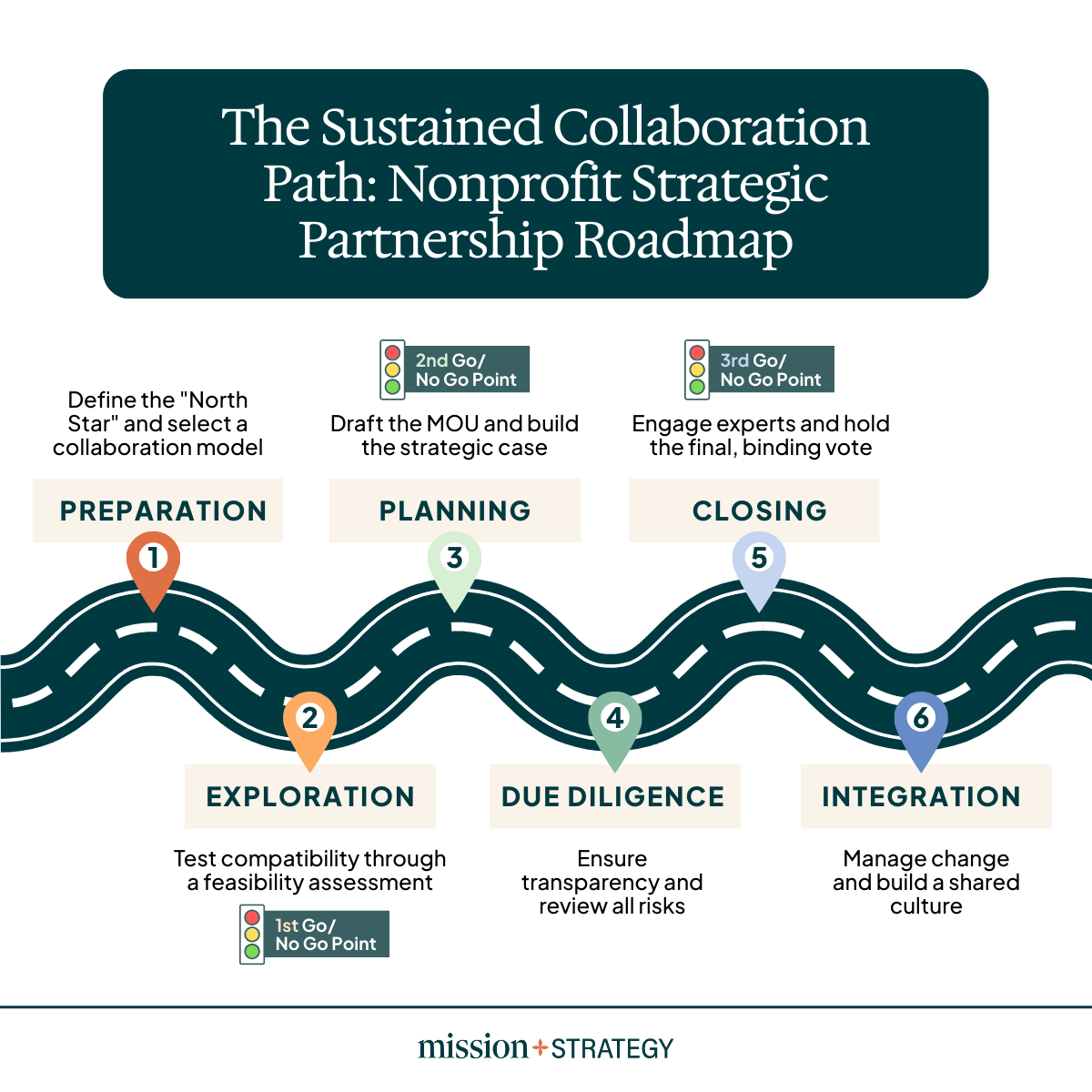
3. Planning: Build the Case
With the LOI in place, the partnership enters a deeper planning phase where vision meets logistics. This is the time to build a compelling case for the partnership and assess cultural alignment.
It is essential to resolve key issues regarding mission, governance and operations while drafting a shared Memorandum of Understanding (MOU). By planning core functions like HR, IT and finance in detail, you create a clear path forward. The second Go/No-Go Decision arrives when each Board formally votes to approve the MOU.
4. Due Diligence: Build Trust Through Transparency
Transparency becomes paramount as you identify and exchange due diligence items. This phase is not just about paperwork; it is about building the trust necessary for a long term commitment. Both organizations may also begin partnership fundraising during this time.
Findings are summarized and reported to each Board to provide a clear eyed view of risks and operational realities. This thorough review ensures that both parties are fully informed before moving to the final commitment.
5. Closing: The Final Vote
If due diligence confirms alignment, the partnership moves toward formalization. This involves the preparation and review of final closing documents.
Outside Expertise Makes the Difference
Our own research at Mission + Strategy, the 2016 Chicago Nonprofit Merger Study, found that 80% of successful merging parties engaged a third party consultant or facilitator. These experts help navigate complex negotiations, align stakeholders and manage integration. Most successful mergers rely on outside experts, including attorneys, accountants and merger facilitators.
This leads to the third and final Go/No-Go Decision. Each Board holds a legally binding vote on the closing documents. This marks the formal structural transition into a sustained partnership.

6. Integration: Support People Through Change
The signing of the closing documents is not the end but rather the commencement of a new chapter. Integration is where the partnership becomes real. We often think about these partnerships as transactional, but helping people navigate change is crucial to success. As expert Peter Senge aptly puts it, "People don’t resist change. They resist being changed!"
Joint committees help implement the MOU and execute the plans developed earlier. Integration is an evolving process where teams refine their approach as new insights emerge. By intentionally cultivating a cohesive and inclusive workplace culture, you honor the legacy of both organizations while creating something stronger together.
Key Takeaways for the Long Term
The journey toward a sustained partnership is a continuous process of growth, adaptation, and mutual learning. By following a structured, 6-step roadmap, nonprofit leaders can move from high level vision to operational reality with confidence. Success is found when you keep your "North Star" in sight, leverage outside expertise to bridge gaps, and prioritize the human side of organizational change.
In the realm of strategic partnerships, the end is truly just the beginning. It is a shared commitment to addressing complex challenges and achieving common goals that will define your impact for years to come.
Frequently Asked Questions About Nonprofit Collaboration
-
Our research shows that mergers often take longer than participants expect. In our 2016 Chicago Nonprofit Merger Study, the shortest process took approximately six months and the longest took three to four years, though most took about a year.
-
Many organizations prefer asset transfers over statutory mergers. Asset transfers allow for greater flexibility and help the lead organization avoid the risk of liability associated with taking on another entity’s past legal or financial obligations.
-
Our study found that 80% of successful merging parties engaged a third party consultant or facilitator. Experts like attorneys, accountants and facilitators provide the objective analysis needed to move from uncertainty to action.

Together, we are stronger.
If you’re interested in strategic partnerships or balancing your mission and business strategies, we’re here to help.

Mission + Strategy is an invested thought partner to your nonprofit organization. Through our Strategic Advising, Mergers & Partnerships, and Shared Back Office service solutions, we help nonprofits achieve alignment between their mission and business strategies.